Despite having a three-tiered roost and plenty of fresh straw for bedding down, the little crazies found a place they like more.
This won't work when they get much bigger. The nights are only in the sixties, so they must just want to cuddle with their friends. It doesn't appear that we have a rooster, so this must be a hen party that goes on into the night.
Wednesday, October 19, 2016
Sunday, October 16, 2016
Magic Beans
Last year, I went to town and got a packet of Black-Eyed Peas.
In summer, I planted less than a dozen beans (they only call themselves peas to seem more appealing).
There wasn't anything on the packet to indicate they weren't what I was expecting, namely a bush bean. They started to grow, whereupon it became obvious that I'd been uninformed. First, they twined around a cage of green peppers, then cast an eye (they have plenty) toward the big daylily nearby. I hastily erected an opened-out tomato cage for them to climb up.
Before long, actually it was while I was sleeping, they had twined right up that. Next, the weight of the huge vines, leaves and long pods of beans caused that fence to fall over, blocking the path for the remainder of the summer. Since I love black-eyed peas, I let them continue.
The disappointing part, however, was most of the beans were tinged with brown flecks due to our humid summer. Hulling them was a lot of bother when most were spoiled.
They were trying. The kindest thing to do was to let them carry on until frost. Today, I started cutting them free from the fencing and the pepper cage. That's when it became apparent that I had in fact purchased Magic Beans.
Most of the vines were over ten feet long, great strapping monsters that probably would have reached the clouds if they'd had something like a cell phone tower to twine around.
Tossing the remainder of the packet out of the window, I vowed to never grow them again.
In summer, I planted less than a dozen beans (they only call themselves peas to seem more appealing).
There wasn't anything on the packet to indicate they weren't what I was expecting, namely a bush bean. They started to grow, whereupon it became obvious that I'd been uninformed. First, they twined around a cage of green peppers, then cast an eye (they have plenty) toward the big daylily nearby. I hastily erected an opened-out tomato cage for them to climb up.
Before long, actually it was while I was sleeping, they had twined right up that. Next, the weight of the huge vines, leaves and long pods of beans caused that fence to fall over, blocking the path for the remainder of the summer. Since I love black-eyed peas, I let them continue.
The disappointing part, however, was most of the beans were tinged with brown flecks due to our humid summer. Hulling them was a lot of bother when most were spoiled.
They were trying. The kindest thing to do was to let them carry on until frost. Today, I started cutting them free from the fencing and the pepper cage. That's when it became apparent that I had in fact purchased Magic Beans.
Most of the vines were over ten feet long, great strapping monsters that probably would have reached the clouds if they'd had something like a cell phone tower to twine around.
Tossing the remainder of the packet out of the window, I vowed to never grow them again.
Labels:
black-eyed peas
Thursday, October 13, 2016
Frost Tonight
Frost warning, so that's it for the summer garden. The chicks will be sad because they have been feasting on largish zucchinis for some time now. The baby cantaloupes set an extra round of melons but most won't ripen. Even the possum isn't interested in them when they are under ripe.
The green peppers are always in fine form finally when the frost finishes them off. From an avalanche of vines, these tomatoes were the only ones that may ripen in a dark closet. The potatoes were a lovely surprise. I didn't get them all dug in a timely manner, so they put on new plants and gave birth to babies. I'll enjoy new potatoes and old potatoes, too.
The last blooms of summer were the tall zinnias. They took their sweet time in growing, for some moody reason. Now that the end is near, they burst into bloom and have loads of buds that will be zapped tonight.
Dahlias and Gaillardias were still growing strong, too.
The spinach and mystery Toy Choys are up, so winter isn't here yet. It always seems a short time between the heat of summer and cold nights. Probably because we have basically two seasons, hot and cold. However, there will be some lovely days between now and the first snow.
Labels:
first frost
Saturday, October 8, 2016
It's a Start
After some nice rain settled the road dust, I'm back at the Great Hillside Project. The bees were finished with the White Heath Asters. One bee did come around while I was cutting them down. I did a little dance to show her there were lots more in the nearby fields. However, I don't believe we both have the same choreographer.
Before the rain, I ran Tillie over the hand-dug parts. I transplanted four of the Butterfly Weed shrubs, now dormant. I was surprised to find they have big roots, most of which are still in the ground.
I started them from seed one year. They were pretty. The next spring, I guessed they weren't going to show up, so I planted some new daylilies there. Surprise! Not wishing to play favorites, I let them all try and duke it out.
Now they can have enough room. I'll plant some of those daffodils around them, so I'll have some pretty blooms while waiting for them to break dormancy, rather late. They are like me, not early risers. Perhaps they are also into astronomy that keeps them up late.
The scrawny bamboo markers show the curve of the planned bed. Most of the weeds now are English Plantain, a solid carpet of them. The moles have kindly helped with the excavation and will no doubt come back when I have everything planted.
Speaking of planting, today I found the seed packet from the Toy Choy bok choy. Wish I'd seen it before I used the saved seeds to plant lots of them the other day. I thought they were open pollinated, but they are hybrids. Who knows what I'll get for all my trouble. I did plant some Melody spinach for spring. It always does better with a fall planting, if I'm not running terribly late. The heat just passed a few days ago.
It was 36 degrees this morning, so Jack Frost is probably going to call soon. The sweet potato vines have taken over the tomato planting and lots of the garden. Hopefully, there are a few tubers in there.
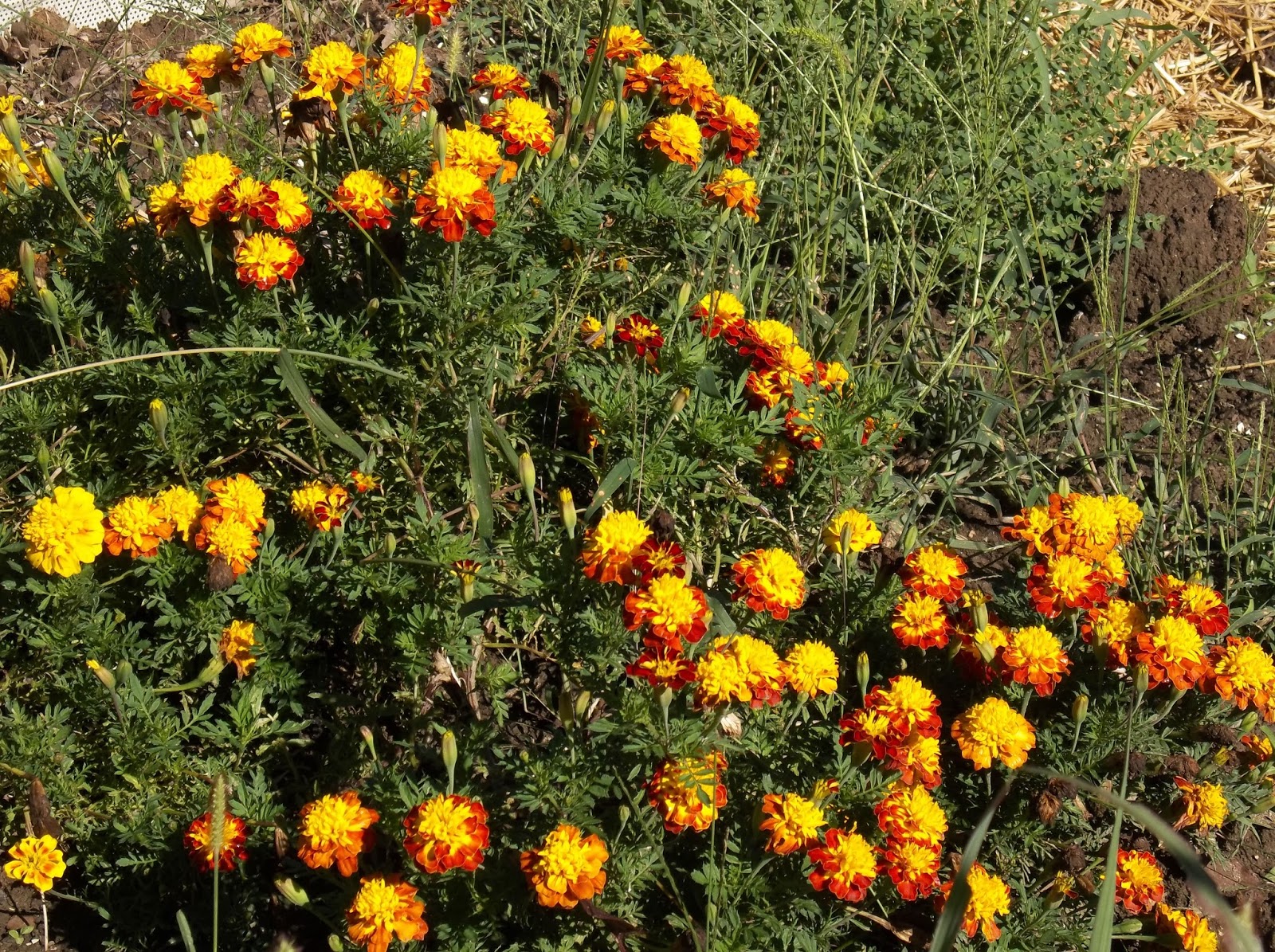
These marigolds in the garden make my eyes glad to look at them.
From four plants, I now have many square feet of autumn blooms, really finer than mums, which are so fleeting and lots more expensive. These are Hero Mix, a much better bargain, $1.50 from Pinetree Garden Seeds. They've been in bloom all summer. Rich, beyond my wildest dreams.
Thursday, September 29, 2016
Surrendering to the Road
The road dust is thick again, with huge combines and grain trucks roaring by. The dust is not good for my lungs, so I avoid it. Perhaps a sign borrowed from a boat marina would help: LEAVE NO WAKE.
My front border has suffered from neglect on account of the dust. My house is too close to the road. So, I made a decision to stop trying to have annuals there. This has only taken me years to figure out. It suddenly dawned on me that having a pretty show of flowers for the passers-by was ridiculous. For one thing, everyone zooms past so fast that all they see is a blur, or my backside as I work the soil.
I shall now confine my efforts for my eyes only. The weedy hill out back will be my new area of interest/challenge.
At the moment, however, there are bunches of wildflowers there that the bees are working. Shrub-like White Heath Asters have taken over spots not already choked by English Plantain and foxtails. Usually, I avoid yanking out flowers in bloom. They don't like it and I feel bad. However, the surrounding fields are crammed with them. I believe the cows don't eat them, preferring to just smell their lovely fragrance and admire the tiny daisy-like flowers.
Now that cooler weather has finally arrived, I can fling myself headlong into transforming the hill into a blooming showplace. That's how we gardeners always start out, with plans that are a tad beyond grandiose.
As I've mentioned, the soil is lovely on that hillside. That's why it's choked with weeds. No need to dwell on that.
To this end, I have ordered a bulb planting auger for my drill. Here are quantities of daffodils that I dug up recently because they needed to be divided. There are some daylilies that I want to transplant in the manner of White Flower Farm's expensive Daffodils and Daylilies collection.
My plan is to also transplant as many of the robust plants as possible. Here are the sage I mentioned earlier. They have lovely blue flowers in springtime and shade out weeds that try and grow under them. Bees and hummingbirds love them. Parts have sometimes died out in a really cold winter, minus twenty degrees, but they have always rebounded.
Best for me to begin with Square Inch Gardening. Today, I started at the end closest to the back of the house and began the slow crawl forward.
Getting the roots out required several things, like the shovel, claw and kneelie. Another was the lawn chair and jar of iced tea with basswood honey.
The beauty of this bed is it gets morning and late afternoon shade. Heading in a northerly direction, I came upon the Lost Iris Planting. The weeds have infiltrated it and the irises will all have to be dug up. That four-foot wedge of dirt was about two hours' worth of digging and sorting. Soon, I'll be able to work the soil with the Mantis and proceed with the Grand Plan, hopefully before the fall rains start.
My front border has suffered from neglect on account of the dust. My house is too close to the road. So, I made a decision to stop trying to have annuals there. This has only taken me years to figure out. It suddenly dawned on me that having a pretty show of flowers for the passers-by was ridiculous. For one thing, everyone zooms past so fast that all they see is a blur, or my backside as I work the soil.
I shall now confine my efforts for my eyes only. The weedy hill out back will be my new area of interest/challenge.
At the moment, however, there are bunches of wildflowers there that the bees are working. Shrub-like White Heath Asters have taken over spots not already choked by English Plantain and foxtails. Usually, I avoid yanking out flowers in bloom. They don't like it and I feel bad. However, the surrounding fields are crammed with them. I believe the cows don't eat them, preferring to just smell their lovely fragrance and admire the tiny daisy-like flowers.
Now that cooler weather has finally arrived, I can fling myself headlong into transforming the hill into a blooming showplace. That's how we gardeners always start out, with plans that are a tad beyond grandiose.
As I've mentioned, the soil is lovely on that hillside. That's why it's choked with weeds. No need to dwell on that.
To this end, I have ordered a bulb planting auger for my drill. Here are quantities of daffodils that I dug up recently because they needed to be divided. There are some daylilies that I want to transplant in the manner of White Flower Farm's expensive Daffodils and Daylilies collection.
My plan is to also transplant as many of the robust plants as possible. Here are the sage I mentioned earlier. They have lovely blue flowers in springtime and shade out weeds that try and grow under them. Bees and hummingbirds love them. Parts have sometimes died out in a really cold winter, minus twenty degrees, but they have always rebounded.
Best for me to begin with Square Inch Gardening. Today, I started at the end closest to the back of the house and began the slow crawl forward.
Getting the roots out required several things, like the shovel, claw and kneelie. Another was the lawn chair and jar of iced tea with basswood honey.
The beauty of this bed is it gets morning and late afternoon shade. Heading in a northerly direction, I came upon the Lost Iris Planting. The weeds have infiltrated it and the irises will all have to be dug up. That four-foot wedge of dirt was about two hours' worth of digging and sorting. Soon, I'll be able to work the soil with the Mantis and proceed with the Grand Plan, hopefully before the fall rains start.
Wednesday, September 28, 2016
The Door Opens on a Wider World
At first, the chicks were afraid to come out when I propped open their door. Chickens are not renowned for their bravery.
Waiting to see how big a zucchini would get, I decided that this was it. I split it open and the chicks came out to get it. Lots of weeds have grown up in the run since there were any chickens using it. It was over the babies' heads and must have seemed like a jungle to them.
As long as I was sitting on my half cinder block watching them, they stayed out. Every few minutes, they would look up to check that I was still there. It was like when I had toddlers; the eye contact was reassuring to them.
They scurried back into the coop when I left to go inside. I had to order a camp stool from Amazon.
Labels:
4-Week Chicks
Monday, September 26, 2016
A Short Rant About Honey Prices
Checking honey prices in the supermarket, I was astonished to find the dark honey labeled "raw" and sold at premium prices. Dark honey is at the bottom of the scale for great honey, right next to road oil.
Here's the deal with honey. Honey is graded by color. The lighter the color, the more value. Any honey from a local beekeeper is no doubt "organic" and not pressure filtered. Raw just means it hasn't been heated. In a small operation, there's no need to not let gravity cause the honey to drip through the mesh strainer. "Raw" sounds unfinished to me.
Not only that, she goes on, but I really can't believe that honey labeled raw and organic and from Brazil is really all those things. What it is is dark and medicinal-looking.
Doing some calculations of what my honey is worth, according to the various jars and bears, I get a range of a minimum of $11 for the quart jar, up to $16.50 for organic and raw. If I were to part with any of the specialty honey, the basswood, I would expect to get $20 for a quart jar, for the premium light color and unique flavor. Anyone who had tasted basswood honey (and could afford it) would be happy to get it.
I used my new spiffy digital kitchen scale and discovered that a quart jar holds not three pounds, but two pounds and twelve ounces of honey. So my calculations were based on that.
One other factor, in addition to all the expense of equipment, is the glass jars, which cost almost a dollar each. From all the above, it is apparent that I intend to sell some honey but don't want to haggle with those who want the price to be cheaper than Walmart.
These jars, filled yesterday, are all the same batch of light, exquisite honey. The ones near the window just have more light shining through them. Beekeepers frequently use the flat-sided glass honey jars to make the honey look one grade lighter. Those jars are lovely but even more expensive than the canning jars.
Fine honey is like fine wine, expensive.
Here's the deal with honey. Honey is graded by color. The lighter the color, the more value. Any honey from a local beekeeper is no doubt "organic" and not pressure filtered. Raw just means it hasn't been heated. In a small operation, there's no need to not let gravity cause the honey to drip through the mesh strainer. "Raw" sounds unfinished to me.
Not only that, she goes on, but I really can't believe that honey labeled raw and organic and from Brazil is really all those things. What it is is dark and medicinal-looking.
Doing some calculations of what my honey is worth, according to the various jars and bears, I get a range of a minimum of $11 for the quart jar, up to $16.50 for organic and raw. If I were to part with any of the specialty honey, the basswood, I would expect to get $20 for a quart jar, for the premium light color and unique flavor. Anyone who had tasted basswood honey (and could afford it) would be happy to get it.
I used my new spiffy digital kitchen scale and discovered that a quart jar holds not three pounds, but two pounds and twelve ounces of honey. So my calculations were based on that.
One other factor, in addition to all the expense of equipment, is the glass jars, which cost almost a dollar each. From all the above, it is apparent that I intend to sell some honey but don't want to haggle with those who want the price to be cheaper than Walmart.
These jars, filled yesterday, are all the same batch of light, exquisite honey. The ones near the window just have more light shining through them. Beekeepers frequently use the flat-sided glass honey jars to make the honey look one grade lighter. Those jars are lovely but even more expensive than the canning jars.
Fine honey is like fine wine, expensive.
Labels:
Honey Prices
Saturday, September 24, 2016
More Honey
Despite the oppressive heat and humidity, it is once again time to bring in some more honey. I always wear duds under the bee suit, not because I am afraid of the bees, but because I think I might do something clumsy and have the entire hive swarming about me. So, I'm pretty warm before I even leave the AC. If the temperature is even above eighty-five outside, all my pores are working overtime to cool me off. When I wring out my headband, there is an appreciable amount of salt water. Okay, it's pure sweat.
There were three supers on the hive. Instead of filling the frames completely on one super before moving up to the next, as I've instructed them many times, the bees have filled and capped the center frames of each super and then gone up and filled the middle frames of the next super. Lots of frames have uncapped honey. The bees are like me with my knitting projects; many things started at once. That's how we are.
I'm finally learning how to use the empty super box to unload some of the heavy frames and save my back. Brushing the bees off the capped frames, I load them into the cart and cover them. I leave the the bees to get out through the bee escape. After a few trips, I'll have sorted the frames that still have honey that is uncapped, and leave that super on for the winter. As I've mentioned, it's not a commercial enterprise.
The smoker, like a barbecue, seems to be at its best when I'm finished with it and driving the cart back to the house. Pine needles are the best fuel. I always add some dried sage. It smells great. I have rather a lot of sage growing in the front border. From time to time, I cut some and hang it to dry in the workshop.
The hive is tipping. I'll need some help to level it soon. There is an extra bee suit and veil that my granddaughter Carolyn isn't using. She was a beekeeper as a teen. Now she and her husband Karl are going to college in Georgia.
Some of the honey from 2014 has granulated in the jars. It's a normal thing. There is a fun moment when I take the lid off and the honey rushes out. I hastily pour off some of the honey, put the jar in hot water in the crock pot and warm it up to liquefy it. Like all honey projects, it's messy, sticky and very tasty.
Wednesday, September 21, 2016
By the Armful
The chicks learned to fly to a breathtaking altitude of two feet. The Reds can now reach the perches.
Ellie and Nellie flew up to my arm, ignoring warnings from the flock that I was not to be trusted. Sitting on a half cinder block limits the amount of time I can accommodate their comfort. As a chair, it's woefully inadequate.
I shall have to tame down the others. Meanwhile, I have a bracelet that makes me laugh.
Friday, September 16, 2016
Welcome to Fort Flocks
Arriving in the pet carrier, the six chicks are now running around in the coop. They are a challenge to photograph, they move so quickly.
They worked as a team to bite the few weeds peeking through the opening left by the extension cord. The coop is constructed of metal siding, with a metal door. Hence, Fort Flocks. Nothing bigger than a half inch can get in, but I still worry about them.
Ellie and Nellie come up to my hand and let me pet them and pick them up. The others are far too busy scratching excitedly in hopes of finding some tiny treasures they can gobble up. The Rhode Island Reds streak across the straw as I sit on a cinder block watching their antics.
At night, they burrow into the fresh straw near the hanging heat lamp, oblivious of the hysterical yipping outside. The coyotes are out carrying on under the full moon. .
Subscribe to:
Posts (Atom)