Sunday, December 29, 2013

Going All Out for Apples


                       In the spring of 2008, I planted two apple trees.

This one, a Criterion, bore its first small apples last Fall. The other one was damaged by the neighbor's cows when they got out. An old apple tree that was here has lovely blooms every spring but both trees need other varieties of nearby blossoms for the bees to pollinate them.

Last month, I planted another apple tree. I dug the hole before I ordered the tree, since that was the hard part, not to be left until the fall rains made it impossible. I brought in some lovely loamy soil, keeping it in the fruit cellar awaiting the arrival of the tree. Adding peat to the precious dirt at planting time, I shoveled the mix around the roots and watered it in with some fish fertilizer.

The tree is a Golden Delicious. If this isn't an exercise in optimism and patience, I don't know what is. Even though I once grew a very productive Golden Delicious apple tree, it's hard to imagine that this whip will ever amount to anything. Right away, I fenced it from stray cows. The location is better, too, being closer to the outside faucet. It's near the existing old apple tree, some variety of red apple, so they can visit and exchange pollen.

Earlier trees I planted suffered from inadequate pruning in their youth, but my daughter Isabelle is now my adviser on such things. She taught me to not leave the low branches, thinking they will increase their distance from the ground. They won't.

For the moment, the new tree is tucked into a snow blanket.

Every day, I look at this thing that would hardly be called a tree and envision it fully grown and laden with apples. While I await fruition of that dream, I've decided to do one more thing to ensure I have more apples than I know what to do with. I'm taking up beekeeping once more. The boxes of wooden hive parts have arrived. I'll be nailing them together in January. Yet another fun outdoor hobby!

Wednesday, December 4, 2013

No Hens a Laying

Betty, the only hen old enough to lay eggs, was apparently content to lay her eggs in a corner nest. She molted and stopped laying about the time the three pullets joined the flock. Getting a nest box up before spring was a rare instance of me anticipating a need early.


With the advent of cold weather, I'd turned my attention to cutting firewood, but a few nice days gave me the conditions I needed to complete the double nest box I'd started for the hens.

When I looked up the recommended dimensions online, I found that each nest box should be about a foot square. However, larger was better, on account of two hens wanting to lay in the same one at the same time. Some of the ones I looked at were made of plywood. Too flimsy, I thought.

There were all those 2 x 6's in a pile from when my old porch was dismantled. Perfect, I thought. Even the bottom of the box was made of 2 x 6's. Talk about overkill! I failied to notice that the assembled tiers were going to weigh 'way too much for anyone to pick up. Did I mention that the floor of the coop is not very sturdy? So, I had to come up with a way to mount the Hummer box without adding to the problem of the flimsy flooring.

Any fool would have abandoned the prototype and found some lighter lumber, but I'd already invested a lot of effort making the Big Box, so proceeded to get it mounted. Large brackets seemed to be the answer. I screwed them into the studs, then screwed the three layers of the box above them. Considering weight somewhat belatedly, I used a piece of metal for the top. It was a bear to cut.
 It may require some sort of perch for the hens to access it. I could install a hen lift.

Another carpentry lesson learned: figure the final weight of the project! Lucky I wasn't building a glider.

Monday, November 25, 2013

Adorable New Tenants

Stacking some wood on the rack in the fruit cellar, I noticed some dark stuff high in the far corner. It looked like maybe mice had made a nest upstairs in the workshop and it had worked through to the cellar. On closer inspection, I realized it was two tiny bats.


They are Little Brown Bats, only about three inches long, and they probably came to hibernate where the temperature doesn't get below freezing. A few days later, it was warmer, so I left the doors open for them to get out and gobble up some of the many insects that were flying around. When Lissa came up, I told her I had new critters. She was as delighted as I was with such a rare find.

Later, there was only one of them and it had moved to another wall. The other one may still be on the far wall, but they are so small they are easy to miss. Now I am tiptoeing around, trying not to disturb them. Lissa told me to stop taking pictures because the flash disturbs their sleep.

I put a remote temperature sensor down there, which shows that it stays in the mid-thirties, their perfect hibernation zone. I'm leaving the door open about an inch for them to get out. Lis did some research and found they squeeze through a small opening. Not as I thought, an aerial maneuver in the style of a Spitfire aircraft.

They aren't an endangered species, but they are threatened, so it is an honor to provide habitat for such helpful little mammals.

Friday, November 8, 2013

Digging for Treasure

A few of weeks ago, I dug up the sweet potatoes. Frost was forecast and there was a nip in the air.

This was one of the best tubers. My terra preta soil was great for them.


Even though I was trying to be careful, I managed to break the biggest ones in the process of getting them out of the ground. Most of them grew straight down and stuck fast in the clay soil at the bottom of the raised bed.

So, there was nothing for it but to can them in the pressure canner. In addition to these seven pints, I had plenty to eat right away. They are so beautiful, I'd put them on display, but light isn't good for them. There will be tours of the pantry for interested parties. Okay, I'll make everyone who comes here look at them.


Tuesday, November 5, 2013

Getting Ready for Spring

Did I mention that carpentry isn't my best skill? However, that doesn't stop me from building things.There were these 2 by 12 pieces of lumber left by the folks who lived here before, so I cut them for a cold frame. On the second tier, I had to use some 2 by 6's, too. The cistern provided a level place to work.


The wood had been lying out in all weather for years. Since I wasn't going to try and nail into what was probably nearly petrified wood, I drilled pilot holes and used deck screws. Having always been put off by the idea of cutting the top on the diagonal to slope toward the sun, I took the easy way out and decided to just tilt the thing in the ground. The two sections actually matched and the fine double-glazed window found in an outbuilding fit perfectly. It was a big surprise to me.

The next step was a bit of a disaster. I had a tube of expired Silicone caulk that was very hard to squeeze out of the gun. I pressed the rope caulk into the cracks, whereupon it stopped being hard and became a big sticky mess. Later, it looked a lot like wax. It gave me a big lesson on using material that expired in 2010.

Later, I asked Lissa to help me carry the heavy open boxes to the garden. She carried them easily by herself, declining my puny help. She even finished excavating the hole in the clay soil that I had started. She's such a dutiful and helpful daughter.

Even though we just came through another dry summer, hope springs eternal in this gardener's heart. Come spring, I'll start some plants in this contraption and try again. I may even get some horse manure from a herd of Palominos down the road and make it into a hotbed of seed-starting.

Thursday, October 17, 2013

Hoops Covered

The spinach wanted their own hoop, even though they can come through light frosts easily. The chard was fine without it yet.


Got the plastic over the hoops for a trial run. The sticks mark where I planted garlic for next year.
Here is the view from the top tier, where the sweet potatoes are ready to be dug any day now. The tomatoes are still bearing but only ripen after I take them in the house. There are still a few green peppers left. Anything that is still edible is most appreciated in October. The first picking of the green beans were delicious last night, with chard quiche made with Betty's eggs. Bliss.

Monday, October 14, 2013

Hoop La

Some nice green beans were just starting to bear this week. Then a couple of  nights ago, the temperature sank to 35 degrees, a tad too close to freezing.

It's amazing how motivated a person can get when frost threatens. Abandoning my cold frame project, I leaped into action to save the green beans. Poor things, their early growth had been hampered by a lot of bean beetles. When I finally noticed the damage, I dusted them with rotonone and the bugs were no more. So, having been through so much, they begged me to think of something, lest they be cut down in their prime.

For years, I've wanted to rig up some sort of low hoops in the fall garden. Today, I figured out how to do it without spending any money, always a plus and a must for me. I had leftover plastic sheeting from my storm doors tent that turned out to be yet another of my early prototypes. That sounds so much better than one of my bad ideas.

There are lots of rolls of heavy, rusted fencing here and there. Some came from a fence that was between me and me, where the former owners let the neighbor's cows roam in their field. Basically, they had fenced a little yard for themselves and left the remaining ten acres for the cows. Call me selfish, but I wanted all my land for myself. Incidentally, fencing that has been in the ground for years resists being ripped from its moorings. It lets sapling trees grow up and they present a united front against change.

The bolt cutters were needed to cut the thick old wire. I got four seven-foot lengths.From being in a roll, the fencing naturally developed a nice curve, perfect for my project. I only got punctured once, but will check to see if my tetanus shot is still good tomorrow. It was just a flesh wound.


The fencing is held in place by the tiers. The next row up is chard and spinach. Perhaps I'll make a cover for them. Even if it was not the work of an instant, at least didn't take all that long.

Blooming now, these really cute beans are Top Crop, a variety which were quite tasty in an earlier planting. There were enough to freeze a few packages for winter.

The little bean plants emerging along the tier were only planted to enrich the soil. They are some pinto beans I had in the kitchen. Even with the hoops covered in plastic, they probably won't have time to amount to a hill of beans.


Saturday, September 28, 2013

Digging In for the Autumn

Having at last gotten some rain, I could resume my soil improvement efforts. This compulsion to turn over the ground must be a basic survival instinct that has atrophied in sensible people.

The former strawberry bed is one of my recent revitalizing projects. I had plywood pieces over it all summer to kill the invasive but not productive strawberries and the dock, chicory and red clover. The chicory didn't die, so had to be dug up with a shovel. I read that they are great for the soil, but they are not a lot of fun to wrestle out of the earth.
They bring up nutrients from deep in the earth, possibly from China. I read up on how to use chicory for coffee but it sounded like more effort than I cared to expend on ersatz coffee.
This small part of the old strawberry patch required me to loosen the dirt with a shovel, separate the many roots from the soil clinging to it and later till the area. I added broken-up cow manure, pelleted gypsum and limestone, tilled it again and planted it to a cover crop of pinto beans.

The rusty grocery cart is upside down to protect a volunteer cantaloupe from critters. Volunteers usually don't ripen in time, but I'm a sucker for holding out hope that this will be the year that they make it. One year, I did have good luck with growing the vines up through the cart, making a modern cornucopia. 

Cultivating this spot  was a tremendous amount of work but will no doubt be worth it when it can once again be used for garden crops. It was part of the no-topsoil stretch left by the former owners. Apparently weeds care not if they have topsoil or adequate rain.

Meanwhile, my efforts at making Terra Preta in the top tier have paid big dividends. After just a year, that soil is so rich and loamy that I was able to dig the last of the potatoes with my fingers. I added more cow manure and limestone and buried a bucketful of kitchen garbage. Nothing to do now but await fall rains and spring.
The nearby sweet potatoes are being left in the ground until frost, since I read that they develop the biggest tubers late in the season. I read that last year right after I dug them up a tad too early. My daughter Izzy started these for me in the early spring and they have done well with lots of watering.

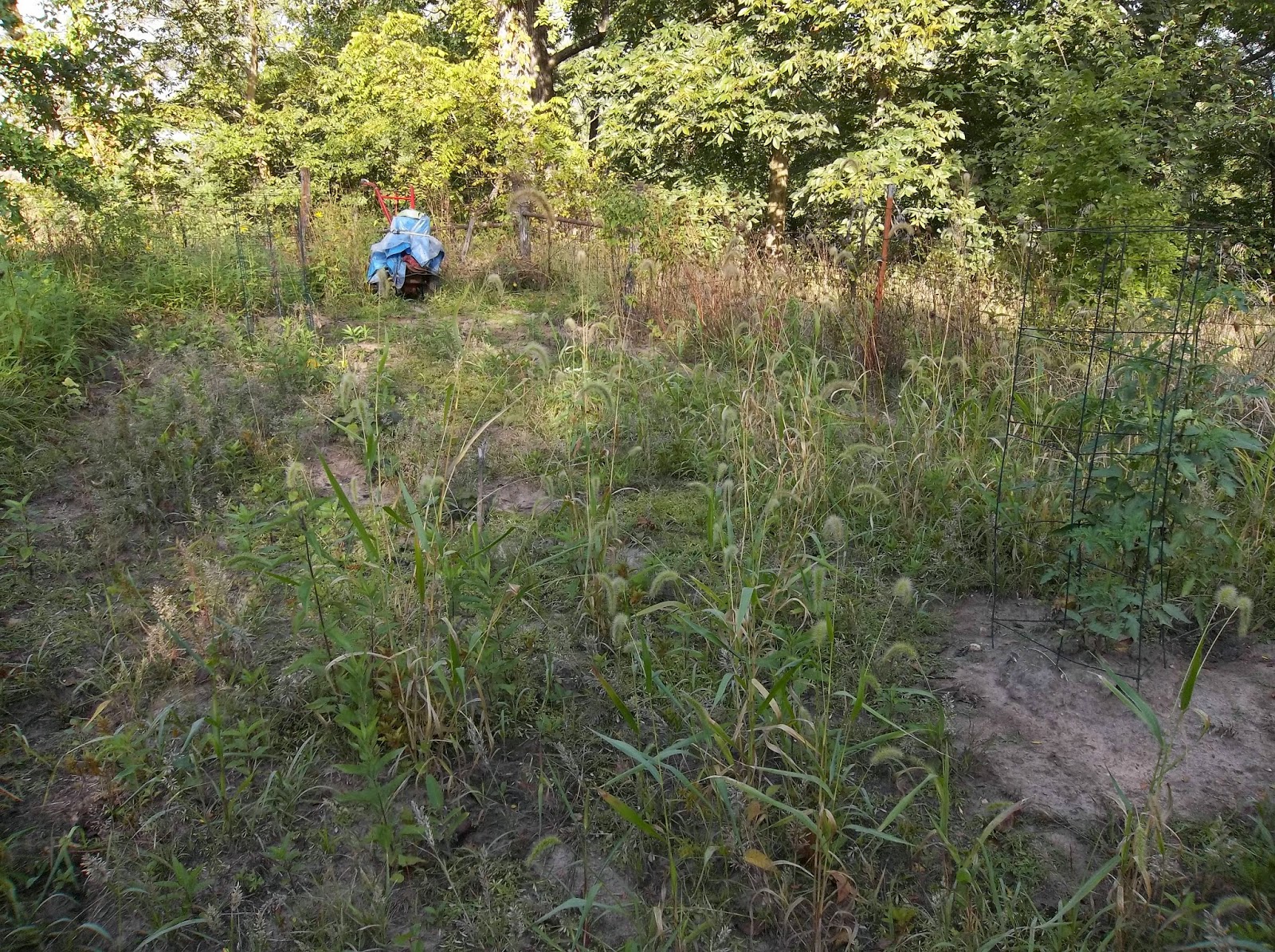
The next project was to run the big tiller over the once again failed Remote Garden. Like other farmers in the area, I have to rely on summer rains to grow crops up there. If the rains fail to show up, we try again the following year. 
The remaining tomato plant finally started growing after some rain, but it was too late for it to amount to anything. Left to possibly mature in the middle of the plot were some sweet potatoes.  I pulled up a lot of these weeds to allow the soil to dry out slightly. 


After making a few fixes to Big Red (the few that were fortunately within my scope) I worked in a tub of cow manure (that had to be carried up the steep path) and achieved this marvelous tilth. Later, I have plans to incorporate leaves and more manure. That's as soon as my muscles get over being so stiff I can barely walk.

Friday, September 27, 2013

Peep Show

It wasn't good timing for me to need a bag of scratch grains for Betty and Rupert.  The farm supply store was having Chick Days again. Cages of peeping chicks are too adorable to pass by. Lissa encouraged me to get two. I took home three, a Barred Rock, a Buff Orphington and a Rhode Island Red.

They peeped all the way home, in their tiny box on the front seat of the car. They settled into their new cardboard box nursery, where they soon were tuckered out and fell asleep. That was the last time they were quiet in the daytime.

Betty never got broody, so it was up to me to raise some more chicks while the weather was still hot. Chicks are a good entertainment investment, changing daily as they grow to big hens. One morning, Buffy caught a moth. It was good for an impromptu game, with each chick snatching it from the other until it was finally gobbled up.

Every few hours, their water needed to be changed because they scratched pine shavings into it.The new heat lamp wasn't needed for the first nights because we were having an awful heat wave. The babies were safe from the cats and raccoons in the workshop at night. In the daytime, they went out for fresh air in the shade, with a secure old fan screen on the top of the box.

My chicken adviser, Lissa, told me they needed room to exercise. Now that they are a few weeks old,they are taking flying hops around the U-Scratch cage I made for Betty Hen. She turned out to be a lot of trouble to transport and the rooster was left alone in the run, crowing all day long for his lost love.

The chicks, Babs, Buffy and Beatrice, regard me with fear, despite all I've done to make them happy. Getting into the cage to collect them for the night is lots of fun. I found that having the Pet Taxi on end was much better for containing them until they could all be rounded up. Okay, I only found that out after they kept popping back out the door. It did make me laugh. They are the only hysterical critters on the place, resisting my soothing efforts to tame them down.

They are still fascinating, learning new things daily. There are lots of young dandelion greens in the cage that they finally learned how to eat. I was digging the soil nearby, which reminded me of when my own babies were small. I took them out in their baby seats to watch me work in the garden. Isabelle and Lissa, who have March birthdays, enjoy gardening, but Chris, who was born on Halloween, too late for gardening, does not.

Maybe these chicks will turn out to be great garden weeders. Probably not.

Wednesday, September 11, 2013

Astronomy Cats

Last night when I was stargazing on the back deck, one of the feral cats got brave and came up to eat from the cat food bowl by the telescope. "Midnite" is very wild. I can't leave food out for the cats all night because it attracts raccoons and possums. They attract Beau, who keeps vigil at the sliding door. He goes berserk and wakes me up in the middle of the night.

When I lived in a little town, I went out at night in the snow with my new telescope. I had to rig up a poncho on the clotheslines there to block out some of the many stray lights. It didn't, however, block out stray cats. I had a lawn chair to sit on and found it occupied a lot by Wild Thing, the first of the feral family I called The Wilds.

They lived in an abandoned barn about a block away. The mama cat, Sweetie,  brought me two kittens to feed the following spring, Funny Face and Oreo. Oreo was still young when she encountered something that got hold of her tail. The vet said it was probably an engine belt. It was an expensive operation, and she had to be kept in the garage while she recovered from her tailectomy. Returning from work in the late evening, I would take a book out there and sit with her so she would tame down.

Later, I introduced her to the house cats. Little Mittens was accidentally hit  by Lissa one night. She thought he was dead and took him in her truck to bury him. He revived on the way home and surprised her by being extremely wild. She recovered from her injuries, tamed him down, got him neutered, then brought him to me.

Stormy was a tiny kitten I found in the front yard after a big rain.

When I got to move to the country, I loaded all six fixed cats into carriers and drove them here. Sweetie managed to get out on the long drive and spent the trip on my shoulder, complaining loudly. They all took to the place at once and lived in the playhouse that had a cat door. Sadly, all but Oreo died or went missing in the years that followed. She has always been the most wary, which has kept her alive. Also, sleeping in bed with me, Iris and Bogie is not too dangerous and she is fairly safe from predators on the couch.

Fluffy was even more of a miserable specimen when I first glimpsed her. It's hard for a long-haired cat to live in the wild. Several times, Beau chased her up trees. She did look like a raccoon. This spring, she shed her mat of fur and got much better looking, but hasn't been seen in a while. This was one of her rare daytime visits.

So, my advice for taming wild cats is take up astronomy. Cats trust fellow nocturnal creatures.